
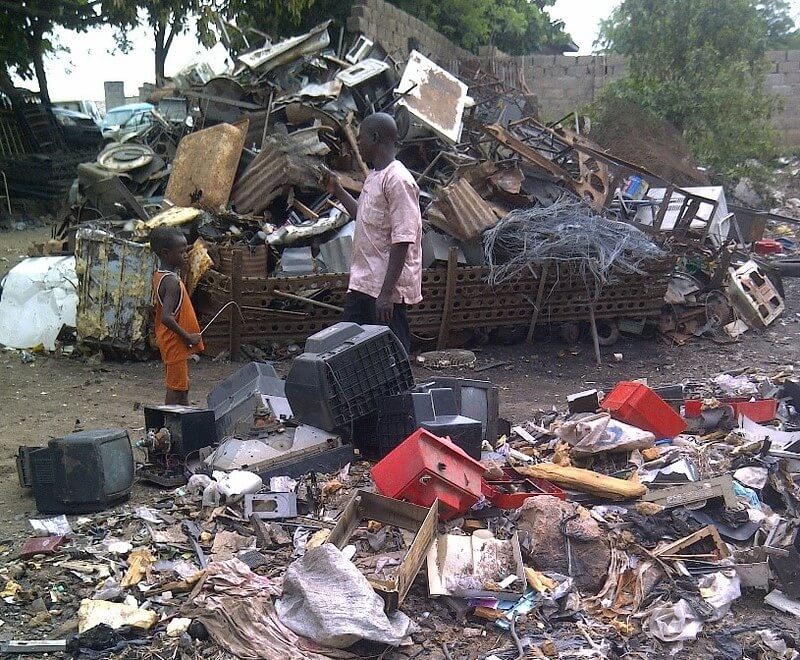
The aggressively extractive advanced technology industry thrives on intensive use of non-renewable resources and hyper-consumerist culture. The environmental impact of its exponential growth means extreme mining, hazardous labour practices including child labour, and exposure burden to inorganic and organic hazardous chemicals for the environment and current and future human generations.
Despite steady progress in the development and promotion of the circular economy as a model, an overwhelming proportion of technological devices discarded by the Global North still finds its way to the Global South, where technology-related environmental health damage starts from the predation of resources and continue all the way to crude recycling, open burning and unsafe disposal.
We draw attention of local research on knowledge gaps such as workable safer methods for technology-critical elements (TCEs) recovery from end-of-life products, secondary materials and e-waste, environmental bioremediation and human detoxification.
We demonstrate how the role of unjust North-South dynamics is evident even in the environmental levels of minor trace elements and that the premise underlying attempts to solve the problem of e-waste dumped in Africa through recycling and disposal technology is in fact misleading.
The influx of foreign electrical and electronic equipments should be controlled and limited at frontiers by clearly defining what is a ‘useful’ second-hand device and what is e-waste; risks arising from device components or processing by-products should be managed differently, and scientific uncertainty and One Health thinking should be incorporated in risk assessment. Along with economic, political, social, and cultural solutions to the e-waste global problem, the scientific approach based on risk analysis encompassing risk assessment, risk management and risk communication can foster a technical support to resist transgenerational e-waste exposure and health inequalities.
We highlight how the technical and political shortcomings in the management of TCEs in sub-Saharan Africa is all the more alarming against the background of unfavorable determinants of health and a resulting higher susceptibility to diseases, especially among children who work in mines and e-waste recycling sites or who reside in dumping sites.
2024. Frazzoli C, Bocca B, Battistini B, Ruggieri F, Rovira J, Amadi CN, Offor SJ, Orisakwe OE. Rare Earth and Platinum Group Elements In Sub-Saharan Africa and Global Health: The Dark Side of the Burgeoning of Technology. Environ Health Insights: 18:11786302241271553.
2022. Frazzoli C, Ruggieri F, Battistini B, Orisakwe OE, Igbo JK, Bocca B. E-WASTE threatens health: The scientific solution adopts the one health strategy. Environ Res: 212(Pt A):113227.
2019. Orisakwe O.E., Frazzoli C, Ilo C.E., Oritsemuelebi B. A. The public health burden of e-waste in Africa. Journal of Health and Pollution. 9,22, 190610.
2018. Frazzoli C, Orisakwe OE, Ilo EC. Electronic waste and Human Health. Reference Module in Earth Systems and Environmental Sciences: B978-0-12-409548-9.02170-9.
2015. Cobelo-García A., M. Filella, P. Croot, C. Frazzoli, G. Du Laing, N. Ospina, S. Rauch, P. Salaun, J. Schafer, S. Zimmermann. COST Action TD1407: Network on Technology-Critical Elements (NOTICE): From environmental processes to human health threats. Environmental Science and Pollution Research 22(19):15188-94.
2013. Frazzoli C, Mantovani A., Orisakwe O.E, Electronic Waste and Human Health, Earth Systems and Environmental Sciences, Major Reference Works, Elsevier, ID 02170.
2010. Frazzoli C, O.E. Orisakwe, R. Dragone, A. Mantovani. Diagnostic health risk assessment of e-waste on the general population in developing countries’ scenarios. Environmental Impact Assessment Review, 30:388–399.
2010. Orisakwe OE, C. Frazzoli. Electronic revolution and electronic wasteland: the west / waste Africa experience. Journal of Natural & Environmental Sciences 1:43-47.